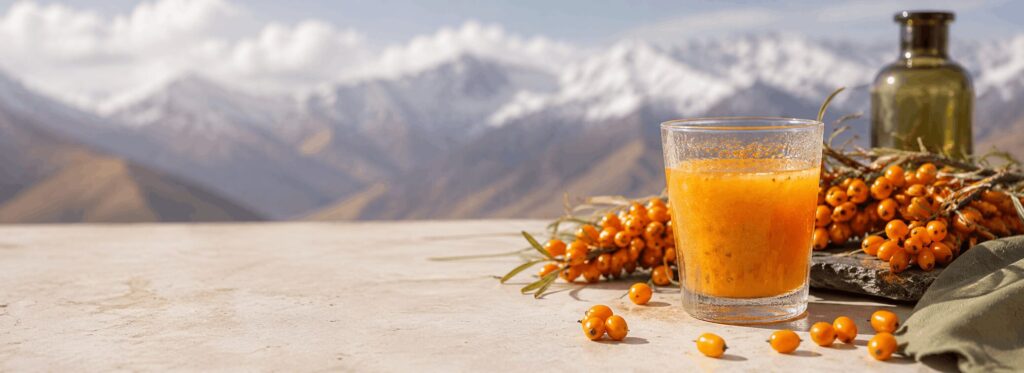
Sea buckthorn is a small orange-yellow berry that grows in demanding climates across parts of Asia and Europe. Its sharp, tangy flavour is as distinctive as its colour. Although it has a long history of traditional use, modern interest is largely connected to its varied nutritional composition.
It is worth understanding what sea buckthorn is—and what it is not—before adding it to a daily routine.
A berry with a varied natural profile
Published scientific reviews report that sea buckthorn berries can contain vitamin C, carotenoids and polyphenolic compounds. Their exact composition varies with the plant variety, growing conditions, harvest and processing method.
This variation is important. A berry may be naturally nutrient-rich, but that does not mean every finished product contains identical amounts. Only a product’s verified nutrition panel or laboratory report can confirm what is present in a particular serving.
Pulp and oil are not the same product
Sea buckthorn is sold in several forms, including pulp, juice, powder, seed oil and berry oil. These formats should not be treated as interchangeable.
Pulp retains the fruit-based character and tangy taste, while oils are concentrated fat-based extracts. Their serving size, composition and intended use can be very different.
Always follow the instructions for the exact format you have purchased.
JK NATURAL Sea Buckthorn Pulp is a pulp product. It should not be described or used as sea buckthorn oil.
How to make it part of a routine
For JK NATURAL Sea Buckthorn Pulp, mix 10 ml in approximately 200 ml of water, or follow the latest directions printed on the bottle.
Shake the bottle if instructed on the final packaging, because natural pulp may settle.
Its naturally tart character can make it refreshing when diluted. Do not assume that increasing the quantity will provide faster or greater results. More is not automatically better.
Keep the bigger nutrition picture in view
Sea buckthorn can add variety, but it cannot replace a balanced diet.
Adults should still aim to eat a wide range of vegetables, fruits, pulses, whole grains and appropriate protein sources.
WHO recommends at least 400 grams of fruits and vegetables per day for adults and children over ten. Rather than expecting one product to carry the entire responsibility, use sea buckthorn as one element within a diverse routine.
Who should ask a doctor first?
Speak with a healthcare professional before adding a new supplement or concentrated botanical product if you:
- are pregnant or breastfeeding;
- take regular prescription medicines;
- have an ongoing liver, kidney, bleeding or metabolic condition;
- have known food or plant allergies; or
- are preparing for surgery.
Stop use and seek advice if you experience an unexpected reaction.
The product should not be used to treat an infection, replace prescribed medicine or delay a medical consultation.
Look beyond exaggerated claims
Sea buckthorn is interesting enough without calling it a miracle berry.
Responsible wellness communication should separate its documented nutritional composition from claims that have not been established by strong human research.
Choose a product with clear directions, intact packaging, appropriate storage information and transparent labelling.
The takeaway
Sea buckthorn pulp offers a convenient way to explore a distinctive fruit as part of a varied diet.
Keep the serving sensible, follow the label and judge it as part of your overall routine—not as a shortcut around healthy habits.
Add Sea Buckthorn to Your Day
Add the bright, tangy character of JK NATURAL Sea Buckthorn Pulp to your day. Order from jknatural.in or Amazon.